
Build models
Create finite automata, grammars, pushdown automata, Turing machines, transducers, regular expressions, and L-systems.
Formal languages and automata
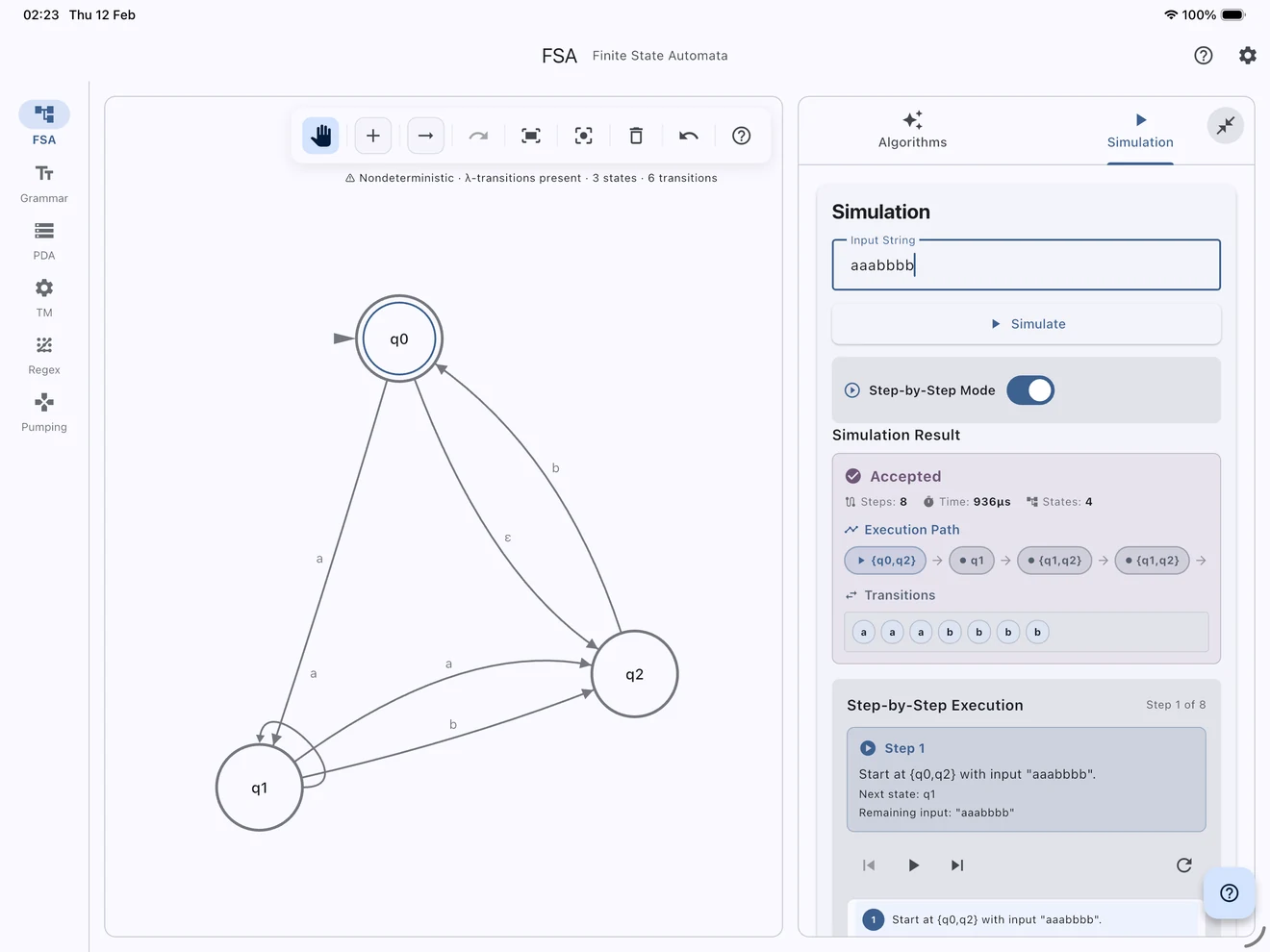
Turing Lab is a touch-friendly workspace for studying automata, grammars, transducers, Turing machines, regular expressions, and L-systems.
Create models, run bounded simulations, inspect step-by-step traces, and explore transformations in one focused learning environment.
01 / Capabilities
Move from an idea to a working model without leaving the same study environment.
Create finite automata, grammars, pushdown automata, Turing machines, transducers, regular expressions, and L-systems.
Run bounded simulations and inspect the state, transition, stack, tape, or output trace that explains each result.
Compare, validate, simplify, convert, and analyze formal systems with explicit diagnostics and compatibility information.
02 / Local-first study
Turing Lab runs its learning workflows locally and includes bundled examples for offline study. No account or developer-operated backend is required.
See the Privacy Policy for the complete data-collection statement.
03 / Designed for learning
Use Turing Lab for classroom demonstrations, lab exercises, research exploration, or self-study. The interface adapts from touch-first mobile layouts to larger workspaces.